Businesses today have more options for accessing workplace technology without purchasing every laptop or desktop outright. Two commonly discussed approaches are laptop rental and Device-as-a-Service (DaaS).
At first glance, they may appear similar because both can provide organisations with access to IT devices through an agreed payment arrangement. However, they are not designed to solve exactly the same business challenge. Laptop rental primarily provides flexible access to IT devices according to an organisation’s operational requirements. DaaS 360 addresses a broader challenge by bringing technology financing, hardware and software, lifecycle management, sustainability, security, IT-Managed services and device recovery into one integrated solution.
The question is therefore not simply: “Should we rent laptops or choose DaaS?”. A more useful question is: “Do we mainly need access to IT devices, or do we need a broader solution to manage technology across its lifecycle?”
What Is the Main Difference Between DaaS and Laptop Rental?
The biggest difference is scope. Laptop rental allows an organisation to access laptops and other IT equipment for an agreed period without purchasing every device outright. The duration can vary depending on the business requirement. Rental may support project teams, workforce expansion, operational requirements, replacement cycles or organisations that simply prefer a more flexible approach to accessing IT hardware. The service may also include additional support depending on the provider and agreement.
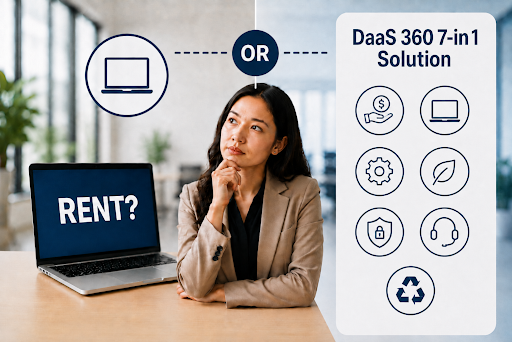
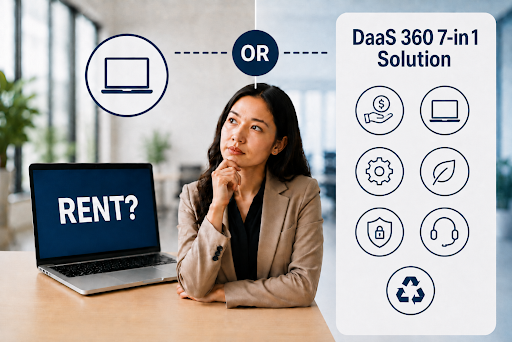
DaaS takes a wider view of the organisation’s technology environment. Instead of focusing primarily on access to the IT hardware, a comprehensive Device-as-a-Service solution considers what happens throughout the technology lifecycle. For DaaS 360, this broader approach is delivered through its 7-in-1 model: Technology Financing, Hardware & Software Supply, Device Lifecycle Management, Carbon Neutral Computing, Security, IT-Managed Services and Device Recovery.
Put simply: Laptop rental helps organisations access the IT devices they need. DaaS 360 helps organisations manage a wider technology environment through an integrated solution.
Where Does Laptop Rental Fit?
Laptop rental can be an effective option when an organisation wants greater flexibility in the way it accesses workplace IT devices. A business may prefer rental when expanding its workforce, opening a new office, equipping a project team, refreshing ageing IT equipment or avoiding a large upfront IT hardware purchase. The requirement does not necessarily have to be short term. An organisation may rent IT devices for different periods depending on its workforce strategy, financial planning and operational requirements.
For larger enterprises and government organisations, rental can also provide another way to align IT device capacity with changing workforce needs without permanently increasing the organisation’s owned IT hardware inventory. The main purpose remains straightforward: provide employees with the right IT devices through a more flexible IT hardware-access model.
Where Does DaaS 360 Fit?
DaaS 360 becomes relevant when the organisation’s challenge extends beyond obtaining the IT devices themselves. Consider an enterprise managing hundreds or thousands of employees across departments and locations. The organisation needs laptops and desktops, but it must also think about how technology is financed, which IT hardware and software should be deployed, how IT devices are secured, how users are supported, when technology should be refreshed and how IT assets are recovered when they are no longer required.
Managing each requirement independently can create multiple vendors, separate contracts and additional administrative work for finance, procurement and IT teams. DaaS 360 is positioned as a comprehensive, AI-driven Device-as-a-Service solution designed to bring these requirements into one connected technology model.
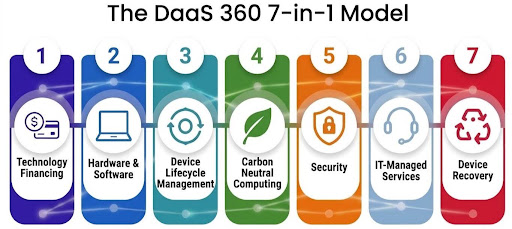
Its 7-in-1 model combines:
- Technology Financing to provide more flexible ways to structure technology expenditure.
- Hardware & Software Supply to equip employees with appropriate IT devices and applications.
- Device Lifecycle Management to manage technology throughout its useful period.
- Carbon Neutral Computing to connect technology strategy with sustainability and ESG considerations.
- Security to help protect workplace IT devices, users and organisational information.
- IT-Managed Services to support and manage the technology environment.
- Device Recovery to provide a structured approach when IT devices reach the end of their intended use.
The value is therefore not simply access to a laptop. It is the ability to manage multiple technology requirements through a more integrated approach.
Why Does the Difference in Scope Matter?
The difference becomes more important as an organisation’s technology environment becomes larger and more complex. Providing 100 laptops is one requirement. Managing 100 laptops across their complete lifecycle is another.
IT teams may need to oversee IT device configuration, software, security, performance, user support, maintenance, replacements and future refreshes. Finance teams need visibility over technology expenditure. Procurement teams may be coordinating different suppliers and contract terms. Sustainability teams may also need to consider IT device recovery, reuse and ESG objectives.
When these activities operate separately, organisations can experience more handovers, fragmented accountability and additional administrative work. DaaS 360’s integrated model is designed to simplify this environment by connecting different parts of the technology lifecycle within one wider solution. For enterprises and government organisations, this can help streamline IT resources, reduce unnecessary complexity and support greater business continuity.
Does Laptop Rental Compete with DaaS 360?
Not necessarily. This is one of the most important distinctions. Laptop rental and DaaS 360 can address different levels of the same technology requirement. An organisation may use laptop rental when it wants flexible access to IT devices while still managing most other technology responsibilities internally. Another organisation may require a broader solution because IT device access is only one part of a much larger operational challenge.
In that case, DaaS 360 can provide a framework for managing technology financing, hardware and software, security, lifecycle requirements, managed services, sustainability and recovery. The decision therefore does not have to be treated as a strict “either-or” choice. The organisation should first determine what level of technology management it actually needs.
Can Laptop Rental Form Part of a Wider Technology Strategy?
Yes. Laptop rental can support an organisation’s wider technology strategy when flexible IT device access is required alongside other IT services. For example, an enterprise may require laptops for a growing team while also needing better IT device lifecycle visibility, security management and technical support across its wider workforce. The device-access requirement and the technology-management requirement are related, but they are not identical.
This is where a more integrated approach becomes useful. Instead of treating IT hardware access, security, IT support and device recovery as completely separate decisions, organisations can consider how these requirements fit together across the complete technology lifecycle. DaaS 360’s wider solution model is designed around this principle.
What Should Your Organisation Assess First?
Before comparing monthly prices or contract structures, organisations should define what they actually need from their technology environment. The starting question should be:
“Do we primarily need flexible access to IT devices, or do we also need help managing the wider technology lifecycle?”
If the main requirement is access to laptops or desktops, a rental arrangement may provide the flexibility the organisation needs. If the requirement includes broader responsibilities such as technology financing, hardware and software planning, security, device lifecycle management, IT support, sustainability and recovery, a comprehensive DaaS approach may provide greater value.
Organisations should also consider the scale of their workforce, number of locations, internal IT capacity, security requirements, device refresh strategy and how technology is currently managed across departments. The right model should solve the operational requirement rather than simply provide the lowest monthly IT device price.
Why Is DaaS 360 Relevant to Enterprises and Government Organisations?
Large organisations often manage technology across multiple departments, offices and user groups. Their technology requirements may involve finance, procurement, IT operations, cybersecurity, sustainability and IT asset management at the same time.
This means technology decisions cannot always be approached as isolated IT hardware purchases. DaaS 360 is designed for organisations that need a more comprehensive way to manage workplace technology. Its AI-driven approach supports proactive technology management while its 7-in-1 model connects different requirements across the device lifecycle. For enterprises and government organisations, this can help reduce fragmented technology management, provide clearer accountability and allow internal teams to focus more effectively on strategic priorities. The objective is to simplify technology management while supporting operational performance, cost-effective digital transformation, ESG goals and business continuity.
DaaS vs Laptop Rental: What Does Your Business Actually Need?

The answer depends on the problem your organisation is trying to solve. If the main requirement is: “We need flexible access to the right IT devices,” then laptop rental may be an appropriate solution.
If the requirement is: “We need a more integrated way to finance, deploy, secure, manage, support and recover technology,” then DaaS 360 addresses a much broader business need.
For some organisations, IT device access may be enough. For others, the real challenge is managing an increasingly complex technology environment across hundreds or thousands of users. Understanding that difference allows organisations to select a technology approach based on operational requirements rather than assuming that every subscription, lease or rental model provides the same level of service.
Frequently Asked Questions
Is DaaS the same as laptop rental?
No. Laptop rental primarily provides flexible access to IT devices for an agreed period. DaaS can cover a much wider technology environment by combining devices with financing, lifecycle management, security, IT-Managed services, sustainability and recovery.
Is laptop rental only suitable for temporary requirements?
No. Laptop rental can support short- term requirements ranging from 1 day to 1 year or longer-term business requirements up to 3 years depending on the agreement and the organisation’s technology strategy. Its defining characteristic is flexible access to IT hardware rather than the duration alone.
When should an organisation consider DaaS 360?
DaaS 360 becomes more relevant when an organisation needs more than access to IT hardware. This may include technology financing, hardware and software supply, lifecycle management, security, managed IT services, sustainability requirements and device recovery.
Can enterprises and government organisations use laptop rental?
Yes. Laptop rental can support enterprises and government organisations when flexible access to workplace IT devices is required. Organisation size does not determine whether rental is appropriate.
Can laptop rental and DaaS form part of the same technology strategy?
Yes. IT device access can form one part of a broader technology requirement. An organisation may require flexible IT hardware access while also needing security, lifecycle management, IT support or device recovery across its wider environment.
What is included in the DaaS 360 7-in-1 model?
DaaS 360’s 7-in-1 model combines Technology Financing, Hardware & Software Supply, Device Lifecycle Management, Carbon Neutral Computing, Security, IT-Managed Services and Device Recovery.
Choose the Technology Approach That Matches the Real Requirement
The right technology decision begins with understanding the scope of the problem. Laptop rental gives organisations a flexible way to access the IT devices their workforce requires. DaaS 360 addresses the wider challenge of managing technology across its lifecycle.
Through its comprehensive, AI-driven 7-in-1 Device-as-a-Service model, DaaS 360 brings together Technology Financing, Hardware & Software Supply, Device Lifecycle Management, Carbon Neutral Computing, Security, IT-Managed Services and Device Recovery.
For enterprises and government organisations, this integrated approach can simplify technology management, optimise internal IT resources, support ESG objectives and strengthen business continuity.
Explore DaaS 360 and speak with our team about the technology approach that best fits your organisation’s workforce, IT environment and operational requirements.
Tech Simplified. Business Optimised.